The coronavirus pandemic has been a wake-up call for patients-as-consumers, seeking lower-touch health care services at home or closer-to-home in community health hubs. The need for a holistic platform the serves up a continuum-of-care tools across the patient journey became evident in a matter of months, Capgemini Research Institute calls out in The Health Fix, a research report assessing peoples’ perspectives on health care in the Age of COVIOD-19.
Capgemini conducted a survey among over 2,000 consumers living in France, Germany, the United Kingdom, and the U.S. in mid-June 2020.
 The report found three big shifts in global health citizens’ views on their personal health and health care delivery in the wake of the pandemic:
- Across all age groups, COVID-19 exacerbated peoples’ concerns about their physical and mental health in a very short time
- Peoples’ interest in digital health technologies has accelerated due to the pandemic, from interest in virtually-conducted clinical trials and remote health monitoring for chronic conditions to fitness and wellness apps
- “Empowered Consumers,” more likely to be older people living with a mate, with higher incomes dealing with a chronic condition, are more likely to embrace technology to support their self-care.
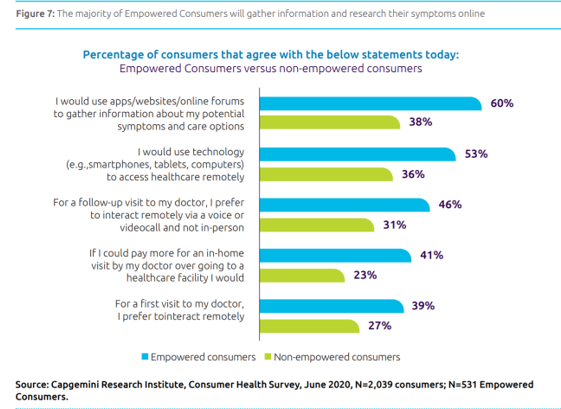
The segment of empowered consumers would more likely use digital technologies as shown in the first bar chart. This graph compares consumers’ demands by digital health channels for accessing various points of care across personal health care life-flows.
For example, nearly two times as many empowered consumers versus non-empowered would be interested in paying more for an in-home visit by a doctor compared with going to a health care facility for a face to face encounter. Similarly, 50% more empowered consumers would use technologies like smartphones and tablets to access virtual care versus less-empowered patients.
 The second chart demonstrates patients’ preferences for using digital health tools before and in the advent of the coronavirus experience. By mid-June, one-third of Baby Boomers said they would use apps and websites to gather information about symptoms and care options; and one in four would purchase devices to help track an existing condition or to help track exposure or predisposition to a disease.
In fact, post-COVID-19, older consumers’ appetitute for using apps, websites, and online forums, as well as for buying health gadgets, shows higher growth compared with younger peoples’, Capgemini calculated.
These trends point to more care being demanded by patients outside of the legacy care system, at home and via more virtual platforms. Capgemini offers recommendations to providers, pharmaceutical companies, and medical device manufacturers to tap opportunities outside of inpatient settings and, increasingly, to the home and digital device.
Health Populi’s Hot Points: Welcome to the era of contactless payments, contactless commerce, and indeed, health care when it can be delivered with a “lower touch.”
“Home is the new point of care,” Capgemini concludes, as consumers increasingly demand, “low-touch healthcare options.”
The more beautifully-designed and digital health devices in a consumer’s Internet of Healthy Things at home can connect to a health care data ecosystem, the more virtual care can be delivered in that safer, hygienic, lower-cost setting: the patient’s own residence.
That’s a big if: in the U.S., patients’ electronic health records lack the level of interoperability that the COVID-19 pandemic could have better leveraged. Former National Coordinator for Health IT Dr. Farzad Mostashari co-authored a report with Dr. Mark McClellan, former FDA Commissioner, and colleagues at Duke’s Margolis Center for Health Policy, on how the U.S. could develop a national COVID-19 pandemic surveillance system. Specifically,
“In collaboration with states and the private sector, CDC, CMS and the Office of the National Coordinator for Health Information Technology (ONC) should encourage the adoption and widespread use of electronic standards and reporting to enable rapid electronic reporting of COVID-19 related laboratory test results from health care providers, laboratories, or other testing sources using existing automated electronic reporting infrastructures. This process can
be enabled by designating COVID-19 as reportable to state and local health officials, and as a nationally notifiable condition that must be reported.”
Of course, this requires cross-agency and cross-health care industry collaboration on a national basis.
“There is no time to lose,” the team insists. “We need to implement the tools and policies to conduct more effective surveillance, containment, and case management for the future. Building these capabilities now will accelerate our ability to assure the public’s safety,”
All consumers, whether super-Empowered or less so, will expect cross-sector collaborative efforts to streamline their patient experience. That’s the required sausage-making behind the scenes of Capgemini’s bullish forecast on digital health consumers.
The post The Home and Low-Touch Health Care – a Health Consumer Update from Capgemini appeared first on HealthPopuli.com.
The Home and Low-Touch Health Care – a Health Consumer Update from Capgemini posted first on https://carilloncitydental.blogspot.com

No comments:
Post a Comment